"People's reactions to opera the first time they see it is very
dramatic; they either love it or they hate it. If they love it, they will
always love it. If they don't, they may learn to appreciate it, but it will
never become part of their soul"- Edward Lewis, Pretty Woman
 |
| Photo Credit: Richard Hubert Smith, 2014 |
As someone who purports to love theatre in all its wondrous forms, I am
slightly shamefaced to admit that I have never seen a live opera.
I have watched a number of them curled up on
the sofa with a mug of tea courtesy of Sky Arts, but I have never experienced
the wonder of being sat in a theatre and letting the music just wash over
me.
 |
| Photo Credit: Richard Hubert Smith, 2014 |
Therefore when
Glyndebourne offered me the chance to come and see one of
their touring shows at the Marlowe theatre, I jumped at the opportunity.
 |
| Photo Credit: Richard Hubert Smith, 2014 |
Glyndebourne tours their Summer Festival shows, which meant that over a
three day period, they were presenting three individual operas: La Traviata, The
Turning of the Screw and La Finta Giardiniera.
As it happened, I was off work on annual leave the week that they were
visiting Canterbury (it was performance week for House of Bernada Alba), so I
was on stage every evening at the Gulbenkian Theatre which ruled out all
evening operas for me unfortunately.
Luckily there was a matinee performance of La Finta Giardiniera.
It finished at 5.30pm, I needed to be at the
theatre to get ready at 6.30pm – it was fate.
 |
| Photo Credit: Richard Hubert Smith, 2014 |
My Mum was also free, so I did what any good daughter would do, and offered
her one of the two tickets that Glyndebourne had so kindly gifted me.
I also invited her to take me out to lunch at
Deeson’s first (OK, I did offer to pay, but apparently that violates a few laws
of nature in her book and I wasn't going to argue).
 |
| Photo Credit: Richard Hubert Smith, 2014 |
 |
| Photo Credit: Richard Hubert Smith, 2014 |
The weekend beforehand, I was at my parents’ house for mum's birthday, and
my sister presented me with a chart. It's was the love plot of La Finta
Giardiniera (complete with keys that I still don't fully understand). To
say it was complicated was an understatement. Armed only with this
knowledge of what the opera was about, I was a little wary that I wouldn't
fully understand what on earth was happening.
I needn't have worried. Not only was the Italian Baroque Opera, directed by Freddie Wake Walker
supertitled and the characters so fully developed it was easy to follow what
was happening, but we were also treated to an introduction about what to expect.
 |
| Photo Credit: Richard Hubert Smith, 2014 |
The plot is fairly simplistic and filled with stock characters.
Violante / Sandrina, the titular Garden Girl,
is stabbed by her lover, Belfiore for reasons still not quite clear to me at
the start of the opera.
She heals and
decides to adopt a disguise as the Garden Girl
(Sandrina), presumably to avoid her quite frankly violent lover.
Belfiore meanwhile goes and
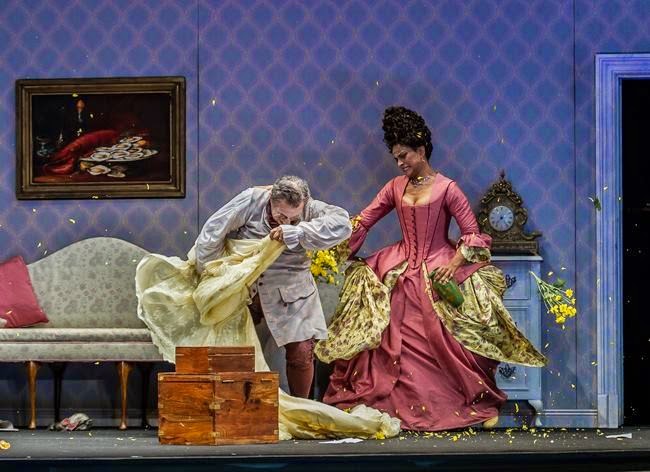
gets himself engaged to Arminda, the snobbish niece in fantastic dresses of the
Mayor (
Don Anchise (Il Podestà). Serpetta is the Mayor’s maid and has a
serious crush on him, whilst Nardo, Sandrina’s fellow servant, is desperately
in love with Serpetta, whilst she scorns him.
Arminda has an ex-lover hanging around her, trying to win her back
(Ramiro) whilst, just to ensure that everything is neat and tidy, Don Anchise is
also trying to win the love of Sandrina.
 |
| Photo Credit: Richard Hubert Smith, 2014 |
 |
| Photo Credit: Richard Hubert Smith, 2014 |
The opera
explores the twists and turns of the convoluted love lives of the seven
characters and becomes especially interesting when Sandrina and Belfiore meet
again, prior to their descent into madness. They recognise each other, much to Sandrina's dismay, forcing her to maintain her pretense. Themes of madness,
the natural environment competing with the rigid formality of the Rococo
interior, spurned love and class boundaries all run throughout the opera, which
was composed by Mozart when he was 19 years old.
 |
| Photo Credit: Richard Hubert Smith, 2014 |
La Finta translates as the False, or The Pretend Garden Girl, and pretense
is a running theme of the production. Not only are we watching actors,
pretending to be characters, but we are also theatre of the disguise, a common theme in French Baroque drama of the time (Violante, the Marchionesse is in disguise as Sandrina, the
Garden Girl). We are also watching characters who are unsure what they
are feeling, pretend to feel emotions, trying them out for size until they find
one that fits. To compensate for this, gestures are oversized and grand,
with each character having a signature stance that they adopt at regular points
throughout the opera (my favourite was Serpetta, her stance reminded me of
Truly Scrumptious' doll pose in Chitty Chitty Bang Bang. She was also
wearing what I am sure were Irregular Choice shoes - a brand I love, which
could also have biased me somewhat...).
 |
| Photo Credit: Richard Hubert Smith, 2014 |
As the characters become more at home in their emotions, recognising their
true selves and their true feelings, everything else becomes stripped
down.
They remove the layers of their extravagant
costumes, wearing only their simple underclothes and bare feet.
Masks of heavy makeup are gradually removed from their faces, revealing the true individual underneath. What is even more impressive is what happens
to the set, which literally disintegrated before our eyes.
I admit, when the first door fell off its
hinges, my immediate reaction was “wow, even professional companies sometimes
experience mishaps”.
Then Sandrina
jumped through one of the flats, leaving tattered remains behind her.
Shortly afterwards another flat crashed to
the floor with a tremendous thump, demonstrating the precision of the staging as it missed Belfiore's head by inches, then two more flats rose into the air.
After that the cast just went to town, ripping the set to pieces around them until only the fireplace
was left standing.
It was around then
that I realised that this wasn’t just a series of mishaps, Comedy of Errors
style.
Replica’s of the furniture from
Act 1 were revealed to be made of paper as the chairs were torn apart, and one
of the legs (a masking curtain) was ripped down.
Good lord that looked like fun!
 |
| Photo Credit: Sam Stephenson, 2014 |
 |
| Photo Credit: Richard Hubert Smith, 2014 |
 |
| Photo Credit: Sam Stephenson, 2014 |
When I had first spoken to my mother about the opera, she has been cautious,
having never been to see an opera before, and just as we were going in she had
said she would ‘keep an open mind’.
At
the interval she was smiling, by the end she had the biggest grin on her face.
She was also slightly bemused at how on earth
they were going to reset everything in time for the next performance.
 |
| Photo Credit: Richard Hubert Smith, 2014 |
There are some reviewers out there who haven’t been particularly
enthusiastic about this work, claiming that due to the fact it is one of Mozart’s
earliest opera’s, it doesn’t have the elegance or finesse of what he was later
capable of.
I’m no expert, and I am
certainly not an opera snob, so from a pure theatre lover’s perspective, they
don’t know what they are talking about.
 |
| Photo Credit: Richard Hubert Smith, 2014 |
This was a joy to watch.
The actors
were fantastic in their characterisation and stamina, the concept was clever
and the music was achingly beautiful.
 |
| Photo Credit: Richard Hubert Smith, 2014 |
Glyndebourne, thank you for having me.
It was a privilege.
*This was a sponsored post. Glyndebourne provided me with two complimentary tickets to their matinee performance of La Finta Giardinieraat The Marlowe Theatre, however this has in no way affected my appreciation of the production. I also would just like to say that they are a joy to work with, and my particular thanks goes to Vicky from Glyndebourne who I have been in correspondence with.
If you like (or hate!) what you have read, please do let me know in the
comments below or slap me with a cheeky follow, or say Hi to me on my
facebook group or
twitter!