Showing posts with label Canterbury Players. Show all posts

Friday, 6 March 2015

Arcadia

Many years ago, I was sat in my English Literature class at school, prepping for my A-Levels.

The topic of discussion was Tom Stoppard's work of art, Arcadia.  For once, I was enraptured with the conversation as we looked at the nature of chaos theory vs order; chaos in science, chaos in love, chaos in sex and chaos in fate, Fermat's Last Theorem, Byron and Japanese cars, the influence of the past on the misunderstandings of the present, Classicism vs Romanticism, dahlia's and a monkey bite, game books and tortoises all wrapped up in a candle lit waltz and some quick fire dialogue, rapier humour and sparkling wit.
Thus began a 15 year love affair with the play.  I am not the only one who loves it either.  A year ago the English Touring Theatre ran a poll to reveal the nation's favourite plays and Arcadia stood out on that list, coming in at number 4. 
Photography Credit Mark Douet
I was fortunate enough to be able to see a production of the Olivier award winning play in 1998 and then I discovered that the English Touring Theatre were bringing it to my home town (Bromley).  As my parents still live there, it was the perfect opportunity to grab some tickets for the Churchill Theatre and then go back to theirs for some of mum's home cooking.
I've tried to describe Arcadia to people who don't know it in so many different ways, but it never comes out quite the way I want it too.

It normally stars with "well, it has my favourite line from any play in it.

Chater:  You insulted my wife in the gazebo yesterday evening

Septimus: You are mistaken.  I made love to your wife in the gazebo.  She asked me to meet her there, I have her note somewhere, I dare say I could find it for you, and if someone is putting it about that I did not turn up, by God, sir, it is a slander

That pretty much sets the tone for the entire play.
Photography Credit Mark Douet
Arcadia is set in two time periods, 1809 and modern day, and all the action takes place in one central room of Sidley Park, the family home of the Croom / Coverly families. In 1809 Septimus Hodge is the tutor to Thomasina Croom, the precocious and endearingly innocent daughter of Lord and Lady Croom.  Lord Byron, the poet and school friend of Hodge, is staying for the weekend.  In the modern day, scholars Hannah Jarvis and Bernard Nightingale are trying to unravel the events of that weekend. 

The title of the play is taken from the longer phrase 'Et in Arcadia ego'; the accurate translation of which is the subject of some academic debate.  Arcadia refers to the pastoral ideal; the phrase literally translates as "and in Arcadia I" but a 1637 painting by Poussin offers the translation of 'Even in Arcadia, there am I', spoken by Death.  This duality of meaning is typical of Stoppard throughout this play as well as foreshadowing events to come; Thomasina's eventual death and Septimus' subsequent madness and self-banishment from society as he tries to prove her theories.

One of the common criticism of Arcadia is that it is frankly too clever by half and can leave you feeling a bit disgruntled.  It is an incredibly wordy play, very 'Stoppardy' (he of the Rosencratz and Guildenstern Are Dead fame), with quick fire dialogue that explores chaos theory, the nature of time and the idea that time, once mixed, like jam in porridge, cannot be unmixed by simply stirring the other way.  Stoppard turns this on its head though by looking at the nature of scholarly historical research, how we interpret evidence and documentation, and how we can form compelling arguments for situations that never happened.  Fabrications born out of our own mind, mountains out of molehills and the significant from the trivial.
Photography Credit Mark Douet
What can never be accounted for is sex, the influence of sex on our actions and how our own human natures can override any form of logical behaviour.  Arcadia is inherently human,and the Director, Blanche McIntryre is quoted as saying that 'it is the only play I know that reaches all four points of the compass...it is intellectually daring and it has the courage to communicate complex arguments to an audience.  It also has humanity and it has wit and it's very rare to find a play with all these qualities".

Characters embody these functions.  Valentine, the modern day eldest son of the household, is cynical, clinical and detached.  He is dry and observant, putting all his faith into his formulas, and yet is thrown at the idea that Thomasina, a home educated 19C, 13 year old girl, could be exploring concepts that have only been in existence for a few years, calculating sums that his laptop needs to process a few million times.  Thomasina alternates between being a precocious, intellectually advanced woman who is grasping around the edges of concepts she does not have the life experience to yet draw parallels with, and a little girl who is still excited at the idea of boiled ham, cabbages and a rice pudding for dinner.
Photography Credit Mark Douet
Lady Croom, on the other hand, is wild and exuberant, an outrageous flirt who rules the house with an iron fist, an lady who is established in position and power and confident in her own overriding sense of presence and intellect, however misguided, whilst Chloe, Valentine's sister is young and naive, sexual but unsure of herself, a flirt but terrified when her flirtations are acted upon.
Photography Credit Mark Douet
Hannah and Bernard are two sides of the same academic coin, one measured, considered and evidence focused, the other arrogant, sweeping and generalising.  As a partnership, they are sublime as they carve small academic chunks out of each other.
Photography Credit Mark Douet
Linking both time periods is the character of Augustus or Gus.  Augustus in 1809, Gus in the modern day.  The same actor portrays both characters, the arrogant young lord who alternates between ordering Septimus around and appealing to him for advice and guidance whilst the shy Gus, completely mute and introverted, provides a gentleness that acts as a counterpoint to Bernard's boisterous nature.
Photography Credit Mark Douet
This particular adaptation, was just scrumptious to watch.  Most of the characters were spot on, as I have always envisioned them being.  Septimus (Wilf Scolding), Lady Croom (Kirsty Besterman), Hannah (Flora Montgomery), Chloe (Roa Zmitrowicz) and Bernard (Robert Cavanah) were just wonderful and an absolute joy to watch.  Hannah Jarvis is an absolute gift of a role for an actress, one of the few well rounded, complex female characters that are out there, and Montogomery was a joy to watch.
Thomasina was good in places, but not as consistent as I would have liked her to be (I couldn't understand her lines in a couple of places, luckily I am very familiar with the script or this would have been a problem).  Chater was, I am sorry to say, an utter disappointment with none of the gormless vanity that I so hoped to see, incredibly stiff and often stood with his back to the audience so his words and facial expressions were obscured.
Photography Credit Mark Douet
I loved the set and lighting in this production - it was simple (as it needed to be for a touring show) but still conveyed the sense of grandeur of the stately home.  Steve was a bit upset that they hadn't bothered to mask and paint the flat joins, particularly on the roof, which did stand out a bit.  The table became almost another character, littered with paraphernalia from both time periods throughout that are juxtaposed together, including the tortoise Plautus (or Lightening depending on your time period).  I was a little annoyed when Bernard's briefcase was left on the table as it completely blocked my view of the artists impression of the gardens; quite an important feature of the play!
Overall though, this play was a delight to watch.  Steve went in absolutely blind, knowing only that it is my favourite play, and really enjoyed it. I would strongly recommend going to see it while you can!  It is on tour until the 18th April - see here for dates and venues.

The reason I was so keen to see this play again, other than the fact that I love it, is that I have been approved to direct it for the Canterbury Players autumn show at the Gulbenkian theatre. 

I think I have quite a legacy to try and live up to.  I have already started my planning process and will be auditioning in the summer.  It is an utterly complex play and every time I read it I get a new insight into a character, an exchange or a concept.  To attempt to realise that is an incredibly daunting prospect  Wish me luck!

If you like (or hate!) what you have read, please do let me know in the comments below or slap me with a cheeky follow, or say Hi to me on my Facebook group or Twitter or Instagram!

Wednesday, 29 October 2014

The House of Bernarda Alba

Next week I take to the Gulbenkian stage with a host of other fantastic women (and a couple of men as well, unusually for this show) for our Autumn production. 
This one has been a long time coming, with a longer rehearsal period than we are used to, but the results of that are really showing!
The House of Bernada Alba, by Lorca, is a 1930's Spanish play, written during the Spanish Civil War when groups of women were starting to question their traditional roles within the household and there was a thirst to throw off the shackles of repression that was endemic throughout rural Spanish culture of the time, a rising movement that was forced into submission when Mussolini invaded Spain.  Lorca was a passionate advocate of theatre as a motivator for social action, and the ideas and ideologies expressed by the more rebellious characters in Bernada Alba, coupled with his own outspoken liberal views and lifestyle, were enough to get him assassinated.  He did not live to see the play performed. 
The House of Bernada Alba was first performed in 1945.  It has since been performed hundreds of times around the world, is studied by school children, acts as a social commentary on rural Spanish life in the 1930's and has been adapted for film and television.
It is an incredibly powerful and intense play, a far cry for the lighthearted and gay Hay Fever by Noel Coward we performed over the summer, but this is one of the joys of amateur theatre - you really get the opportunity to try out your hand at pretty much any genre and we explore all areas of the craft.
We auditioned way back in June for our parts, and I was delighted to be cast as Amelia, the middle sister in the household.  Sally, our Director, has worked incredibly hard with us to draw out our own, individual characters (as the sisters can have a bit of a tendency to blur in the play if you are not careful) and it is this intensive style of rehearsal that has led to a very strong production.
This is a more stylized version than most, with the traditional Spanish elements being used as a reference point rather than dictating the feel of the play.  Costumes, for example, have no particular time period to reference but instead look as though they could be from anytime.  The colour scheme as well is pure black and silver - no other colour is allowed to bleed through, except for Adela's iconic green dress and Maria Josefa's tattered and pathetic wedding gown.
We have also been incredibly lucky to have our very own set of musicians.  Greg, from Green Diesel, has composed an original score for us which permeates through the play.  There are no sound effects, no pre-programmed music cues.  All the sound and music is live, played from the musicians sat amongst the audience or created by the actors voices.  This soundtrack gives the production the oppressive weight of a thunderstorm brewing on the horizon and is extremely atmospheric.  I've heard the music about 30 times now and know the play inside out, but last night, when we had the full set of musicians for the first time, and the action was punctuated by the drum and the guitar and the discordant bass, I felt the hairs on my arms and on the back of my neck rise as though triggered by electricity.  Good lord it was spine tinglingly effective!
As with any production, we have become close as a cast, especially given the fact that we have had a number of drop outs, including having to recast Adela at very short notice (Amy rose to the challenge and was off book before the rest of us, much to our shame!).  One of side-effects of being incredibly cruel and bitchy to each other on stage means that off stage, more often than not we are giggly and affectionate with each other.  There's only so much tearing of each other's hair you can do before you start to feel bad, even if it is only acting.
The amount of physicality this play has demanded has been quite high.  We see women being beaten by walking sticks, pulling each other's hair out, pushing and shoving each other, slapping each other and being dragged around by ropes.  It explores the darkest, most vindictive sides of female nature. 
The play itself is very intense, dark and repressive.  Modern days audiences may find it hard to relate to some of the ideologies expressed by the more traditional characters, with their comments about loose morals, women without men, class and the role of a woman in society, duty and obedience, but it was these very ideologies that Lorca was starting to question and could see being challenged in the world around him.  Lorca, as a homosexual, had an sympathy for oppressed groups, and he expanded this to include women.  Although he was in no way a feminist, in a peculiar way, this is possibly one of the most feminist plays I have ever encountered. 
One of the major challenges has been finding moments of lightness in amongst the oppression and repression of the play, and breaking up the constant tension that pervades through the language.  Our challenge has been to find pauses, snapshots of love and affection between the sisters and their mother.  These moments are few and far between but this makes them all the more important, and as a group we refused to believe that an entire family could only feel hatred for each other. 
We have steered away from the traditional image of The House of Bernada in other ways as well.  It is rare, very rare to have men cast in the production as they are referred to in the script, but never seen.  We have broken that and have a couple of fine gentlemen involved in a variety of roles!  Just wait until you hear them sing! 
We also never leave the stage - when not involved in a scene we hover on the edges, just outside of the light and we watch.  We stand and judge, condemning the action silently and having sentence passed on us in turn by the townsfolk around who add to the claustrophobia.  No matter what we do or how much we squirm, we cannot escape the critical eyes.
This play has been a long time coming - three nights a week, give or take, for three months, but I feel that we have a really impressive show on our hands now.
We have two more rehearsals this week, one on Thursday night and one on Saturday morning, then it is time to go to Wye on Sunday to load the van.  We get into the theatre on Monday, ready for build, and then it is curtain up for the first time on Thursday.
Wish us broken legs please!

If you want to buy a ticket, they are on sale at the Gulbenkian Theatre.  Shows are the 6th-8th November at 7.30pm.

Photo credit:  Les Gordon, from a (non costume) rehearsal

If you like (or hate!) what you have read, please do let me know in the comments below or slap me with a cheeky follow, or say Hi to me on my facebook group or twitter!


Tuesday, 22 July 2014

Hay Fever

Thank you for the "bless you" you just bestowed upon me, but I don't actually mean that sort of Hay Fever.  I'm incredibly lucky in that I have never suffered from it - touch wood - and seeing how miserable it makes some of my friends and family, I'm quite happy living life without it.

I'm not talking about the Hay Fever that makes you miserable.  I'm talking about the Hay Fever that makes you happy!  1920's bohemian farce happy!
I promise you, the audience at least was laughing.

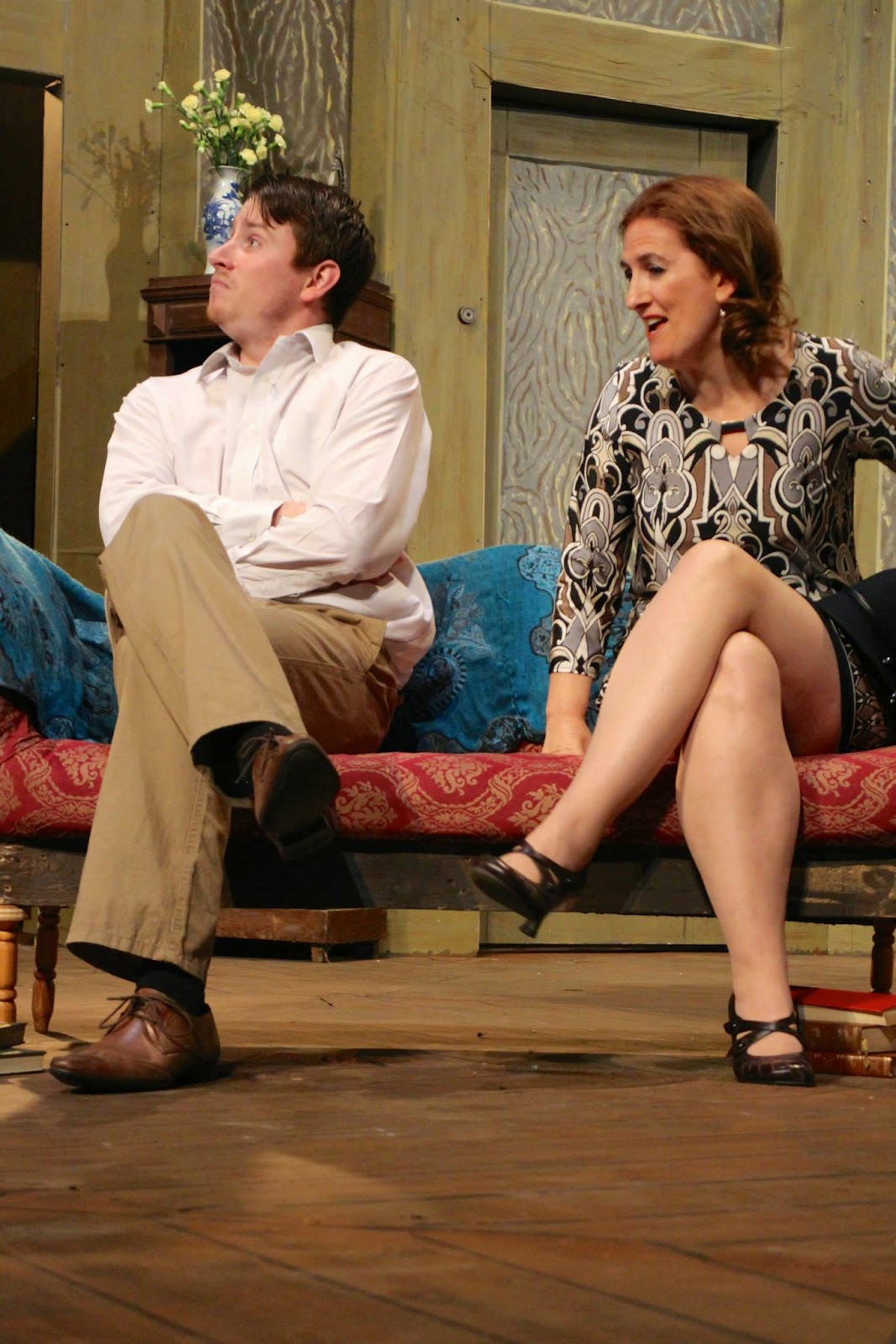
Hay Fever is a Noel Coward play and the latest offering from the Canterbury Players vault.  We performed it in June and, joy of joys, all I had to do for a change was take some pictures!  I was not involved at all.  The Demon Gin was though - this was her directorial debut and I personally think she handled it spiffingly.  Her severely depleted gin supplies may tell a different story.
Steve was heavily involved though - he, along with Derek and Nick, managed to build us one of the best sets I think we have seen in a while.  It looked spectacular, even if it was a slightly more rushed job than normal due to a let down with the company we thought we could rent a set off.  The finished product was spectacular though and in my humble opinion, much better than the one we would have hired.  For starters, it had the right number of entrances and exits needed (5 in total).
So Hay Fever?  Ready for the picture story book as is now traditional on this blog?
At the country pile mansion of the dreadfully bohemian Bliss family, events are starting to get a bit chaotic.  Sorel and Simon, the grown up children of the family, are squabbling as normal and during the course of their discussion realise that both of them have invited guests to stay for the weekend.  A fight breaks out over whose guest gets to stay in the Japanese Room.
During the course of their argument, which is interjected with lots of affectionate phrases, dramatic outbursts and reasonable discourse, we learn that Sorel has a desire to better herself, to make guests feel welcome and that she feels that their family is odd.  We get a glimpse into the workings of the family - the conversation is flighty, never staying on one subject for very long and the outbursts are melodramatic exaggerations.
During the course of the conversation, Judith, the matriarch of the Bliss family enters.  If the children are melodramatic, Judith is insufferable with her absent-minded theatricality.  She is a retired stage actress who longs to return to her doting audiences (the fact that they haven't written begging her to come back is a particularly sore point).
Upon learning that their mother has also invited a guest for the weekend, a heated argument breaks out amongst the three, over the individuals who have been invited and who gets to sleep in the Japanese room.
The noise causes the father, David to enter the room.  David is a novelist who is working on his latest book.  He learns what all the hullabaloo is about, drinks his tea and calmly informs his wife and children that he has invited a sweet, but rather stupid flapper to the house for the weekend so he can study her.
She will be sleeping in the Japanese room and on that bombshell, leaves the rest of the family to process the news and anticipate the looming weekend of horror they each imagine in front of them.  After the children's tantrums Judith admonishes that they must all be "very brave".
Judith announces that she has decided to return to the theatre, possibly reviving one of her old hits, Love's Whirlwind, despite the fact that it is a dreadful play.  She, Sorel and Simon amuse themselves by acting out a melodramatic passage from the play, beginning with the words "Is this a game?  Yes, and a game that must be played to the end!".
These few lines are repeated throughout the play, to the utter bewilderment of their guests.  Just as they are in full swing they are interrupted, much to the anger of Simon and Sorel, by the arrival of Sandy Tyrell.  A sportsman and a big fan of Judith's, he is her guest for the weekend.  Simon and Sorel leave to get ready for the arrival of their guests, but not before being incredibly rude to Sandy.
Alone with Sandy, Judith flirts with him outrageously while he hangs on her every word.  His bubble is somewhat bursts after a passing comment that her husband is not actually dead as he had thought but instead upstairs and writing his novel.
Myra is the next guest to arrive.  A younger rival of Judith's and very vampish, she has been invited to stay by Simon.  She clearly has little time for the particular quirks and foibles of the Bliss family and imparts a few pointed jibes in Judith's direction. Upon her arrival Judith goes into the garden with Sandy.  Myra, alone with Simon, blows hot and cold with him, first leading him on then announcing that she recently had dinner with another man.  Simon reacts like a child, following tantrums with fawning adoration. 
The last to arrive are Richard, a diplomat and Sorel's guest and Jackie, David's guest.  Upon their arrival Simon drags Myra out into the garden, leaving both Richard and Jackie alone in the parlour as they await their hosts. 
The waiting is painful as the two make excruciatingly polite small talk with each other.  There is clearly an intelligence gap between the two.  The pauses between them become longer as they fight for things to stay.  At one point Judith breezes through the room, picks up a sun hat and breezes back out again, humming slightly, without acknowledging either of the two guests sitting awkwardly.  Finally it occurs to them to ring a bell for assistance as they have seen no one.  They ring the bell and wait expectantly, staring at it.  No one comes.
Eventually Sorel comes running downstairs, full of remorse at the fact that Richard has been kept waiting.  She reluctantly shows Jackie the way to David's writing room, then sits and attempts to entertain Richard.  She is full of nervous energy and cannot stick with one idea long enough to see it through.  Richard, whilst a little bemused by the situation, is gracious and clearly fascinated with her.
After Richard has politely fetched the luggage in for all the guests ('assisted' by a relatively inept and over enthusiastic Sorel), the remainder of the guests and the Bliss family join Sorel and Richard in the parlour for afternoon tea.
Conversation is again stilted and awkward amongst the entire party, with Richard and Myra frequently starting new topics of conversation at the same moment as each other and then both falling quiet.  The scene ends in total, agonizingly awkward silence.
The next scene is the same day, following dinner.  The family insists that everyone needs to join in a parlour game, a variety of charades where one person must guess the adverb being acted out by the others.  Sorel volunteers to guess but the Bliss family become frustrated when the guests appear to be incapable of performing to their standards.
As the game breaks up, tempers fare and arguments break out amongst the Bliss's and some of their guests.  Simon drags Jackie out into the garden, Sorel drags Sandy into the library and David, after arguing with Judith, pointedly invites Myra for a walk outside.  She accepts with a triumphant glance thrown back at Judith and swaggers out into the garden with David.
Left alone with Richard, who is awkwardly attempting to ignore everything he has just witnessed, Judith turns her attentions to him.  She flirts with him, sings for him and admires his cigarette case.  He is clearly infatuated and kisses her quickly.
Judith reacts as though she has been shot, screeching out the effect that this will have on David and acting as though she and Richard have been conducting a long, sordid affair.  She completely takes Richard aback when she starts to talk about breaking the news to David.
She orders Richard to wait for her in the Summer House so she can talk to her husband.  Richard quickly leaves, at which point Judith immediately calms down and with a smile on her face, heads to the library.  There, a second screech is ripped from her throat as she discovers Sorel and Sandy kissing.  Judith launches into another melodramatic tirade and then graciously 'gives' Sandy to Sorel.  Sorel, clearly playing along with her mother's histrionics, accepts as graciously whilst Sandy is hard pushed to get a word in edgeways.
Judith leaves and Sorel explains to Sandy that it is all just play acting - that everyone in the house has to play up to Mother.  Much relieved that he is not actually engaged to Sorel, Sandy takes her back into the library.
David and Myra enter from the garden, David delighted that he has found such a pair of willing ears in Myra.  Myra confesses to him that the only reason she accepted Simon's invitation to come to the house was because she knew that David would be here.  The two flirt, argue and then kiss, at which point Judith enters.
Judith, naturally, has an extreme, overly dramatic reaction to what she sees.  She acts the martyr, clearly reveling in the role and releases David from all his obligations to her.  A delighted David promises that she will continue to receive 50% of all his profits and exclaims that he and Myra are now free to marry.  A clearly alarmed Myra trys to halt the rapidly escalating events in front of her, but, like Sandy before her, cannot get a word in edgeways.
The only thing that saves Myra is the dramatic entrance by Simon, who comes running in from the garden violently and announces that he and Jackie are engaged, followed by an extremely shell-shocked looking Jackie.
Sorel and Sandy come running back in from the library, Judith enters yet another bout of theatrics and complete pandemonium breaks out.  In the midst of it all, Richard comes back from the garden and, utterly confused by what he sees happening in front of him, asks 'Is this a game?'.  Simon, Sorel and Judith immediately seize on this and launch into the scene from Love's Whirlwind that they were playing out earlier, to the absolute bafflement of their guests whilst David laughs uproariously.  The scene ends.

The next morning a very nervous Sandy creeps down the stairs, clearly desperate not to wake any members of the family.  He serves himself some breakfast and gulps the food down as quickly as possible.  Upon hearing a noise, he grab a slice of toast and runs into the library.
A cool, calm and collected Jackie walks down the stairs.  She serves herself some food, takes her seat at the table, and promptly bursts into tears.  Upon hearing her cry, Sandy comes out of the library.  He learns that Jackie has no idea what happened last night.  She was walking in the garden with Simon, he suddenly kissed her out of the blue then went running into the house announcing that they were engaged, something she fervently hopes isn't the case.  They talk about how crazy the entire family is and how utterly miserable they both are staying here.  Jackie slept in the Japanese room and hated it as the bed was Japanese style on the floor and she had nightmares about the dragons on the wall.  Sandy gets an attack of the hiccups and Jackie attempts to help him cure them with various techniques.  Upon hearing footsteps, they both retreat to the Library with a cup of coffee that Sandy needs to drink from the wrong side of.
Richard is the next to come downstairs.  He checks the barometer on the wall and accidentally knocks it down.  He hides it under the chaise.  He is joined by Myra, who is the most calm and collected of the four guests, but still anxious to leave.  Jackie and Sandy come out of the Library after breaking a coffee cup much to the ire of Clara, the much put-upon house maid (previously Judith's dresser in the theatre).  Clara informs the party that they have missed the first train and that there wasn't another one for a good few hours.  Sandy notes that he has his motor car with him and agrees to drive them all back to London immediately.  They all go upstairs to pack.
Judith comes down. Clara hands her the Sunday papers and she begins reading aloud to Sorel what the gossip columns have to say about her.  Simon shares his most recent drawing with his mother and sister, and then David enters, brandishing his finished novel and offers to read them the final chapter.
Just before David sits down, Sandy comes running down the stairs, pauses when he sees the family and then runs out of the front door.  Judith remarks that she 'seems to know that boy's face'.  The rest of the family shrug off the occurrence and turn their attention to David who begins reading aloud.  Immediately a full scale argument breaks out over a minor geography detail of Paris and its accuracy within David's novel.  Insults are hurled at each other, with David exclaiming that the children's behaviour is so dreadful he is not even sure if they are his.
The family are so engrossed in their argument that they don't notice the four guests sneaking down the stairs and running out of the front door.  The sound of the door slamming shut, an engine starting and a car driving away finally alerts them to the fact that their guests have all gone.
After Sorel notes that they didn't say goodbye, Judith comments 'How rude' and David adds that 'people really do behave in the most extraordinary manner these days'.  The Bliss' return happily to David manuscript, with David making the geographical amendment to please Judith, and Judith announcing to David that she is returning to the theatre, to the delight of the rest of her family.  They are clearly content in their everyday family life. 
If you like (or hate!) what you have read, please do let me know in the comments below or slap me with a cheeky follow, or say Hi to me on my facebook group or twitter!